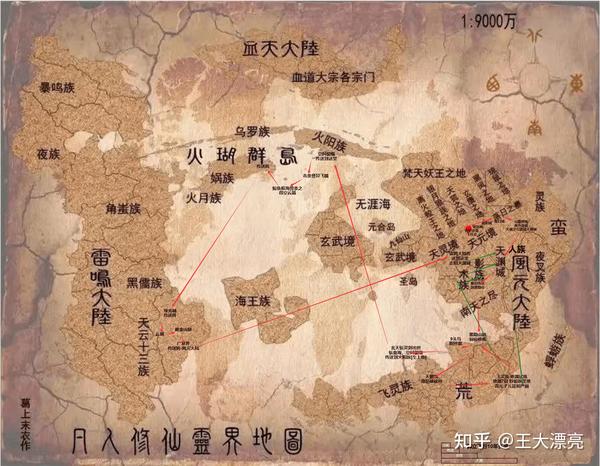
灵界地理全图解
灵界概览:一个超乎想象的庞大世界
如果说人界已经足够广阔,那么灵界的规模就只能用"不可思议"来形容。灵界的面积是人界的数百倍乃至数千倍,天地灵气的浓度更是远超人界。在这片广袤的土地上,山川河流皆有灵性,一草一木都可能蕴含着修炼的资源。韩立飞升灵界之后,花了相当长的时间才对这个全新世界的地理格局有了初步的认知。
灵界的地理特征与人界有着本质的区别。这里的山脉可以高达数十万丈,海洋的深度更是深不可测。更重要的是,灵界的地理格局直接决定了灵气的分布,而灵气的分布又决定了各方势力的实力消长。可以说,理解灵界的地理,就是理解灵界政治的钥匙。
人族核心领地
天渊大陆
天渊大陆是灵界人族最主要的聚居地之一,也是灵界最大的陆地板块。大陆中央地带灵气最为浓郁,是人族顶尖宗门的聚集之处。这些宗门之所以能够传承数万年不衰,很大程度上就是因为占据了灵气最为充沛的风水宝地。
大陆的灵脉分布呈现出明显的中心辐射格局——越靠近中心,灵脉品质越高,灵气越浓。这种地理特征直接导致了修仙界的"马太效应":强大的宗门占据最好的灵脉,优质的灵气又让它们培养出更多的高阶修士,从而更加巩固自身的地位。
韩立初到灵界时落脚于天渊大陆的边缘地带。从边缘到核心的地理迁移,某种程度上也象征着他在灵界实力和地位的不断提升。
各大区域与势力分布
人族领地内部并非铁板一块,而是由数个大的区域组成,每个区域都有自己的主导势力。这些区域之间有天然的地理屏障——巨大的山脉、广袤的沙漠、凶险的海域——这些屏障既是军事防线,也是势力范围的天然分界。
各区域的资源禀赋各不相同:有的地方盛产灵矿,有的地方灵药资源丰富,有的地方则因为特殊的地脉结构而特别适合修炼某种属性的功法。这种资源差异化造就了区域之间的贸易往来,同时也成为利益冲突的根源。
妖族领地:蛮荒与力量
妖域的特征
妖族领地与人族领地有着截然不同的风貌。如果说人族领地已经被高度"开发"——坊市、城池、传送阵网络,那么妖域则保留了更多的原始面貌。巨大的原始森林、无垠的草原、深不见底的峡谷,这些未经改造的自然环境正是妖族所偏好的栖息地。
妖域的灵气浓度并不逊于人族领地,但分布更加分散和不规则。这与妖族的社会结构相呼应——妖族不像人族那样聚集在大型城池和宗门之中,而是以族群为单位散布在广大的区域内。每个大妖族群都有自己的领地,领地的大小和质量直接对应着该族群的实力。
妖族的战略要地
妖域中有数个极为特殊的地理节点,它们对妖族的意义如同圣地一般。这些地方往往具有极端的地理环境——极寒、极热、或者充斥着某种特殊的天地之力。普通修士在这些地方难以生存,但对于对应属性的妖族来说,它们却是修炼的绝佳之地。
这些战略要地的存在,是妖族能够与人族长期抗衡的重要原因之一。它们不仅提供了优质的修炼场所,更是妖族高阶强者突破瓶颈的关键资源。人族多次试图染指这些要地,但都因为地理环境的极端恶劣和妖族的拼死抵抗而未能得逞。
魔族入侵通道:空间裂缝带
位面薄弱点
灵界与魔界之间并非完全隔绝。在灵界的某些特定地理位置,空间壁障异常薄弱,形成了所谓的"位面薄弱点"。这些薄弱点平时处于休眠状态,但在特定的天象条件下会被激活,成为连接两个位面的通道。
这些空间裂缝带主要分布在人族领地与妖族领地的交界处,以及一些偏远的荒芜之地。这一地理分布并非巧合——恰恰是因为这些区域处于两大种族势力的"灰色地带",缺乏有效的监控和防御,才给了魔族可乘之机。
在三族大战中,魔族正是通过这些空间裂缝大举入侵灵界。封锁和摧毁这些入侵通道,成为人妖联盟的首要战略目标之一。然而,空间裂缝的特殊性质使得这项任务极为困难——它们无法被完全摧毁,只能通过强大的封印术暂时封闭。
魔族占领区的异化
被魔族占领的区域会经历一个令人毛骨悚然的"异化"过程。浓烈的魔气会渗入大地,改变土壤的性质,毒化水源,扭曲植被。原本灵气充沛的福地会在短时间内变成灵气稀薄、魔气弥漫的死地。这种异化不仅使得该区域对人族和妖族修士来说变得极为危险,还会向周围不断扩散,如同一个缓慢吞噬灵界的黑洞。
战略要地与禁区
灵脉交汇处
灵界存在数个极为稀有的灵脉交汇点。在这些地方,多条灵脉汇聚,形成了灵气浓度极高的"灵气风暴眼"。这些交汇点是修炼、炼器、炼丹的绝佳场所,其价值无法用灵石来衡量。
每一个已知的灵脉交汇处都被最强大的势力牢牢控制。在这些地方,通常驻扎着至少一位合体期以上的强者,配备着最高级别的防御阵法。争夺灵脉交汇处的控制权,是灵界各方势力之间最常见也最激烈的冲突形式之一。
上古遗迹与禁区
灵界散布着大量的上古遗迹,它们是远古修仙文明的遗存。这些遗迹有的是古修士的洞府,有的是远古战场的遗址,有的则是已经覆灭的古老宗门所在。这些遗迹往往蕴含着珍贵的传承和宝物,但同样充满致命的危险——上古禁制经过漫长岁月仍然威力不减,甚至因为缺乏维护而变得更加不稳定和危险。
灵界还有数个被标记为"绝对禁区"的地域。这些地方可能存在着上古大战留下的恐怖余波,或者是某种天地异象的中心,甚至可能是某位陨落的仙人留下的危险遗产。即使是大乘期的强者也不敢轻易涉足这些禁区。
传送阵网络:灵界的"交通系统"
人族在灵界建立了一个庞大的传送阵网络,连接着各大城池和重要据点。这个网络的重要性怎么强调都不为过——在一个面积如此庞大的世界中,没有传送阵的话,即使是化神期修士也需要花费数年甚至数十年的时间才能从灵界的一端到达另一端。
传送阵网络的建设和维护需要消耗大量的资源,而且高级传送阵的构建需要极深的阵法造诣。控制传送阵网络的枢纽节点,实际上就是控制了灵界的交通命脉。在三族大战中,魔族的一个重要战略目标就是摧毁人族的传送阵网络,以瘫痪人族的兵力调动和物资运输。
地理决定论:为何位置就是权力
综合以上分析,我们可以清楚地看到:灵界的地理格局从根本上决定了其政治权力结构。
占据优质灵脉的势力拥有更强的修炼条件,能培养出更多的高阶修士;控制战略要地的势力拥有更大的话语权和谈判筹码;掌握传送阵枢纽的势力拥有更强的机动性和物流能力。地理优势的积累效应使得强者恒强,弱者越来越难以翻身。
韩立在灵界的崛起之路,从地理的角度来看,也是一个不断向更好的"地理位置"迁移的过程——从边缘到核心,从资源匮乏的荒地到灵气充沛的重镇。这个过程既是他实力增长的体现,也是他权力扩张的象征。
灵界的地理不只是一幅静态的地图,它是一个动态的权力棋盘。每一条灵脉、每一座山峰、每一片海域,都是棋盘上的关键落子。理解这张地图,就是理解灵界一切纷争的根源。
Complete Geographic Atlas of the Spirit Realm
Overview: A World Beyond Imagination
If the Mortal Realm is already vast, then the scale of the Spirit Realm (灵界, Lingjiè) can only be described as "inconceivable." The Spirit Realm's area is hundreds or even thousands of times that of the Mortal Realm, and its concentration of spiritual energy (lingqi) far exceeds the Mortal Realm's. Across this boundless expanse, mountains and rivers possess spiritual awareness, and even a single blade of grass may contain cultivation resources. After Han Li (韩立) ascended to the Spirit Realm, he spent considerable time before gaining even a preliminary understanding of this new world's geographic layout.
Cultural Context: "Ascension" (飞升, feisheng) is a core concept in xianxia fiction. When a cultivator reaches the peak of their current realm's limits, they undergo a tribulation and ascend to a higher plane of existence. The Spirit Realm is the next plane above the Mortal Realm, with richer spiritual energy that enables further cultivation advancement.
The Spirit Realm's geographic features differ fundamentally from the Mortal Realm. Mountain ranges here can soar to heights of hundreds of thousands of zhang (a traditional Chinese unit; 1 zhang ≈ 3.3 meters), and ocean depths are truly unfathomable. More importantly, the Spirit Realm's geographic layout directly determines the distribution of spiritual energy, and the distribution of spiritual energy in turn determines the waxing and waning of each faction's power. Understanding the Spirit Realm's geography is, in essence, the key to understanding Spirit Realm politics.
Human Core Territories
The Tianyuan Continent
The Tianyuan Continent (天渊大陆, "Heaven Abyss Continent") is one of the primary human settlement areas in the Spirit Realm and also its largest landmass. The central regions of the continent boast the richest spiritual energy, serving as the gathering place for humanity's premier sects. The reason these sects have endured for tens of thousands of years without decline is largely because they occupy the most spiritually abundant geomantic treasurelands.
The continent's spiritual vein distribution exhibits a distinct center-radiating pattern — the closer to the center, the higher the quality of spiritual veins and the denser the spiritual energy. This geographic feature directly produces a "Matthew Effect" in the cultivation world: powerful sects occupy the best spiritual veins, superior spiritual energy enables them to cultivate more high-ranking cultivators, which further consolidates their position.
When Han Li first arrived in the Spirit Realm, he settled on the fringes of the Tianyuan Continent. His geographic migration from periphery to core, in a sense, also symbolizes his continuous rise in power and status within the Spirit Realm.
Regional Distribution and Factional Territories
Human territory within the Spirit Realm is not a monolithic bloc but is composed of several major regions, each with its own dominant faction. Natural geographic barriers separate these regions — enormous mountain ranges, vast deserts, and perilous seas. These barriers serve as both military defense lines and natural boundaries between spheres of influence.
Each region has different resource endowments: some areas are rich in spirit ore deposits, others abound in medicinal herbs, and still others possess unique geological structures that make them especially suited for cultivating specific elemental techniques. This resource differentiation gives rise to inter-regional trade while simultaneously becoming a source of conflicts of interest.
Demon Territories: Wilderness and Power
Characteristics of the Demon Domains
Demon territories present a starkly different landscape from human territories. If human territories have been highly "developed" — with market cities, fortress towns, and teleportation array networks — then the demon domains retain a far more primordial character. Enormous virgin forests, endless grasslands, and bottomless canyons — these unaltered natural environments are precisely the habitats that demon races prefer.
The spiritual energy concentration in demon domains is by no means inferior to human territories, but it is distributed more diffusely and irregularly. This corresponds to the demon race's social structure — unlike humans, who congregate in large cities and sects, demons are dispersed across vast areas in tribal units. Each major demon clan has its own territory, and the size and quality of that territory directly corresponds to the clan's power.
Strategic Strongholds of the Demon Race
Within the demon domains are several extraordinarily special geographic nodes that hold the significance of sacred grounds for the demon race. These locations often feature extreme environments — extreme cold, extreme heat, or saturation with some special force of heaven and earth. Ordinary cultivators would struggle to survive in such places, but for demon races of the corresponding elemental affinity, they are ideal cultivation grounds.
The existence of these strategic strongholds is one of the critical reasons the demon race can sustain long-term rivalry with humanity. They provide not only premium cultivation sites but also serve as the key resources for demon high-rankers to break through cultivation bottlenecks. Humanity has attempted to seize these strongholds on multiple occasions, but has been thwarted each time by the extreme hostility of the environment and the demons' desperate resistance.
Demon Race Invasion Corridors: Spatial Rift Zones
Planar Weak Points
The Spirit Realm and the Demon Realm (魔界) are not completely sealed off from each other. At certain specific geographic locations in the Spirit Realm, the spatial barrier is abnormally thin, forming so-called "planar weak points." These weak points normally lie dormant, but under specific celestial conditions they become activated, transforming into passages connecting the two planes.
Cultural Context: The "Demon Race" (魔族, mozu) here refers to the Elder Devils / extraplanar demons — beings from another plane of existence entirely, distinct from the "demon beasts" (妖兽, yaoshou) who are native Spirit Realm creatures. This is a common source of confusion: yao (妖) refers to cultivated animals/beasts, while mo (魔) refers to devils/demons from other planes.
These spatial rift zones are primarily distributed along the borders between human and demon beast territories, as well as in remote, desolate areas. This geographic distribution is no coincidence — it is precisely because these areas lie in the "gray zones" between the two major races' spheres of influence, lacking effective monitoring and defense, that the Elder Devils find openings to exploit.
During the Great War of Three Races, the Elder Devils invaded the Spirit Realm on a massive scale through precisely these spatial rifts. Sealing and destroying these invasion corridors became one of the primary strategic objectives for the human-demon beast alliance. However, the special properties of spatial rifts make this task exceedingly difficult — they cannot be completely destroyed, only temporarily sealed through powerful sealing arts.
The Corruption of Occupied Zones
Areas occupied by the Elder Devils undergo a chilling process of "corruption." Dense devil energy (moqi) seeps into the earth, altering soil composition, poisoning water sources, and twisting vegetation. Lands once abundant in spiritual energy transform in short order into dead zones — spiritually barren and saturated with devil energy. This corruption not only renders the area extremely dangerous for human and demon beast cultivators but also continuously spreads outward, like a black hole slowly devouring the Spirit Realm.
Strategic Locations and Forbidden Zones
Spiritual Vein Convergence Points
The Spirit Realm contains several exceedingly rare spiritual vein convergence points. At these locations, multiple spiritual veins converge, forming "spiritual energy storm eyes" of extraordinarily high concentration. These convergence points are ideal locations for cultivation, artifact refining, and alchemy — their value cannot be measured in spirit stones.
Every known spiritual vein convergence point is firmly controlled by the most powerful factions. At these sites, at least one cultivator of Body Integration stage or above is typically stationed, equipped with the highest-grade defensive formations. Struggles for control of spiritual vein convergence points represent one of the most common — and most intense — forms of conflict among Spirit Realm factions.
Ancient Ruins and Forbidden Zones
The Spirit Realm is scattered with numerous ancient ruins — remnants of a far older cultivation civilization. Some of these ruins are the cave dwellings of ancient cultivators, some are the sites of primordial battlefields, and others are the remains of long-destroyed ancient sects. These ruins often contain precious legacies and treasures but are equally fraught with lethal dangers — ancient sealing formations retain their power even after eons, and the lack of maintenance has in some cases made them even more unstable and hazardous.
The Spirit Realm also has several zones marked as "absolute forbidden areas." These places may harbor the terrifying aftershocks of ancient great wars, serve as the epicenters of certain heaven-and-earth anomalies, or contain the dangerous legacies left by fallen Immortals. Even Mahayana-stage powerhouses dare not lightly tread in these forbidden zones.
Cultural Context: The Mahayana (大乘, Dacheng) stage is one of the highest cultivation realms, named after the Buddhist concept of Mahayana ("Great Vehicle"). In cultivation hierarchy, it sits just below the threshold of true Immortality, representing the pinnacle of what cultivators can achieve within the Spirit Realm.
The Teleportation Array Network: The Spirit Realm's "Transportation System"
The human race has established an enormous teleportation array (chuansong zhen) network in the Spirit Realm, connecting major cities and important strongholds. The importance of this network cannot be overstated — in a world of such staggering size, without teleportation arrays, even a Deity Transformation cultivator would need years or even decades to travel from one end of the Spirit Realm to the other.
Building and maintaining the teleportation array network consumes vast resources, and constructing high-grade arrays requires extremely deep expertise in formation arts. Controlling the hub nodes of the teleportation network effectively means controlling the Spirit Realm's transportation lifelines. During the Great War of Three Races, one of the Elder Devils' key strategic objectives was the destruction of humanity's teleportation array network in order to paralyze troop deployment and supply transport.
Geographic Determinism: Why Location Is Power
Synthesizing the analysis above, we can clearly see that the Spirit Realm's geographic layout fundamentally determines its political power structure.
Factions that occupy premium spiritual veins enjoy superior cultivation conditions and can produce more high-ranking cultivators. Factions that control strategic locations wield greater influence and bargaining power. Factions that hold teleportation network hubs possess superior mobility and logistics capabilities. The cumulative effect of geographic advantage makes the strong perpetually stronger, while the weak find it increasingly difficult to reverse their fortunes.
Han Li's rise in the Spirit Realm, viewed through a geographic lens, is also a process of continuous migration toward better "geographic positions" — from the periphery to the core, from resource-starved wastelands to spiritually rich strongholds. This process is both a reflection of his growing power and a symbol of his expanding influence.
The Spirit Realm's geography is not merely a static map — it is a dynamic chessboard of power. Every spiritual vein, every mountain peak, every stretch of ocean is a critical piece on this board. To understand this map is to understand the root of every conflict in the Spirit Realm.